

SHARE
WARMING OF THE OCEAN DRIVES CLIMATE INSTABILITY
A key driver of climate instability is the warming of the ocean, whose record temperatures have been connected to recent, devastating natural disasters
By Sigrid Vestergaard Frandsen, Director of Environmental Health
04/15/2026
The ocean acst as a massive heat sink. Around 5% of the excess heat from greenhouse gases is warming the land, 1% is warming the atmosphere, and 3% is warming and melting the cryosphere. However, around 91% goes straight into warming the ocean. In 2025, ocean heat content reached a record high, according to the World Meteorological Organization (WMO). All of this added heat has led to more frequent and intense heatwaves across the planet.
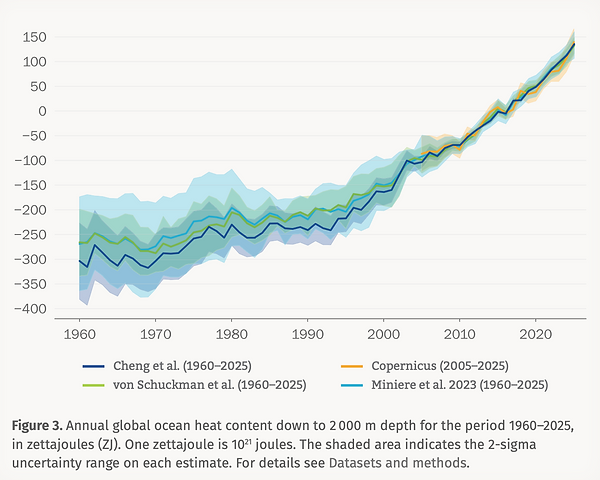
Source: WMO 'State of the Global Climate' Report 2025
El Niño is a weather phenomenon that adds to weather impacts across the planet. El Niño happens when the central and eastern tropical Pacific Ocean become warmer than normal (due to greenhouse gases). This can add to the long-term global warming that has already accumulated, making a hot year even hotter. That’s because ocean temperatures are major drivers of global temperatures, as seen during the 2023 El Niño.
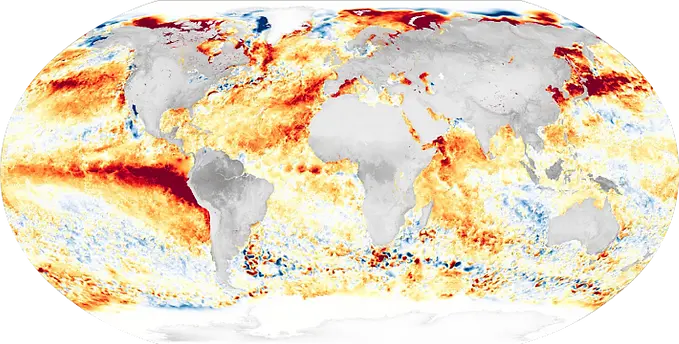
Sea surface temperature anomalies during the 2023 El Niño. Red and orange colours show where the ocean was warmer than normal. Blue colours show where temperatures were cooler. Source: NASA
But ocean warming is altering hurricanes, too, as hurricanes need warm water to form and strengthen. Recent data points to warmer ocean temperatures as the main factor causing more storms to rapidly intensify. Together with intensifying storms, sea-level rise has exacerbated extreme events such as deadly cyclone surges and coastal hazards such as flooding, erosion and landslides, which are now projected to occur at least once a year in many locations. Historically, such events occurred once per century.
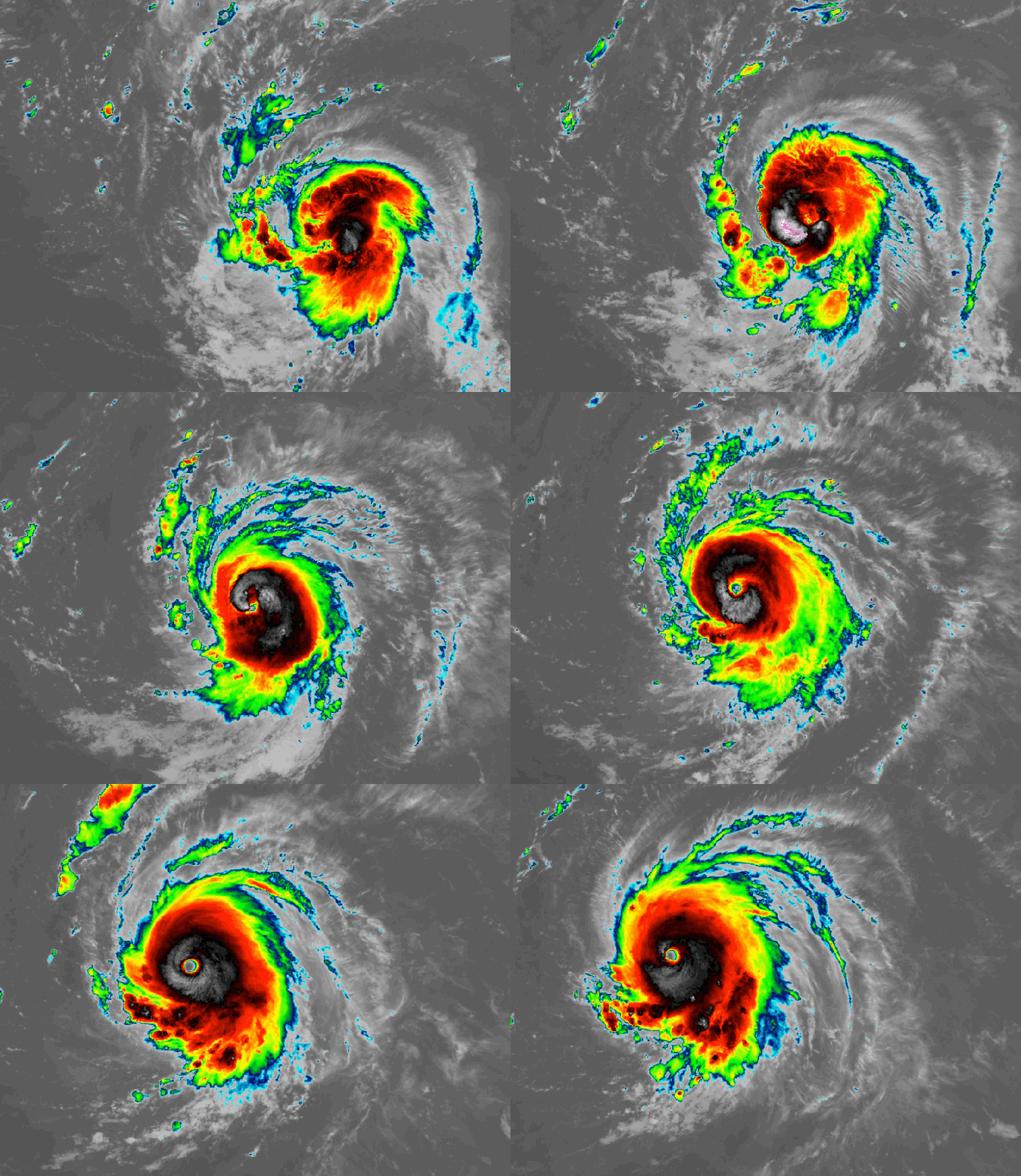
NOAA’s GOES-East satellite captures the rapid intensification of Hurricane Lee during the 2023 El Niño. Source: NASA/NOAA
In fact, global sea levels have risen more than 4 inches (101 millimeters) since measurements began in 1992. As mentioned, the added heat in the air and ocean is also melting the cryosphere (ice sheets and glaciers), adding freshwater to the ocean, and further raising sea levels and slowing down the Gulf Stream. The Gulf Stream is responsible for redistributing heat from the central Atlantic to the Eastern US and, eventually, Europe. This current is the reason why Great Britain and Ireland don't look like the Arctic, with much less snow and a milder climate. But now, cold water melting off Greenland is slowing down the Gulf Stream to the slowest point ever recorded.
If we were to imagine a world with no Gulf Stream, we would experience catastrophic climate disruption, including rapid freezing across Europe, leading to severe agricultural failures and extreme snowfall, while the US East Coast would face rapid sea-level rise.
NASA illustration of how the Gulf Stream moves heat from the Central Atlantic to the North Atlantic, from West to East.
What does this mean to human health?
Aside from the fact that the intensification of storms, floods, coastal erosion, and landslides can wipe out homes and entire villages, causing severe injuries and casualties among inhabitants and leading to displacement, the warming of the ocean can also increase waterborne and other marine-related tropical diseases (like cholera and vibrio).
Vibrio vulnificus is a bacterium that spreads much faster in warmer waters, infecting humans either through consumption of raw or undercooked shellfish or by exposure of open wounds to brackish or saltwater, according to the CDC.
A study by the IUCN found that rising sea levels are causing harmful algal blooms to spread faster, impacting both human health, fishing industries, and local coastal communities. Harmful algal blooms contaminate seafood with dangerous toxins and cause diseases such as ciguatera. Ciguatera causes severe, sometimes lethal, gastric and neurological damage.
Ocean warming is not only an environmental issue but a human one. Billions of people rely on the ocean for food, livelihoods, and climate stability, from coastal communities to global fisheries. As marine ecosystems shift and decline, these impacts ripple outward—affecting lives, economies, and migration patterns on a global scale.
This is not a distant or isolated process, but a slow, powerful force that connects melting ice in the Arctic, intensifying storms in the tropics, and shifting food systems worldwide. Understanding ocean warming is therefore not just about protecting our climate. It is about recognizing the ocean as the planet’s heartbeat—and realizing that as it changes, so too does the stability of life on Earth.